Air Pot, Vacuum Jug or Beverage Pot? Building a Reliable Coffee and Tea Service

Air Pot, Vacuum Jug or Beverage Pot? Building a Reliable Coffee and Tea Service

Every hotel, restaurant, and conference venue faces the same daily challenge: keeping coffee and tea genuinely hot from the moment it is brewed to the moment it reaches the guest’s cup. Electric urns keep liquid hot at the brewing station, but they are fixed, power-dependent, and impractical for table service, conference rooms, or in-room amenities.

That is exactly where insulated servers come in — and yet the names used for them are some of the most inconsistently applied terminology in hospitality equipment. An air pot, a vacuum jug, and a beverage pot are all insulated, all stainless steel, and all designed to keep hot drinks hot. But they are not the same product, and choosing the wrong format for a given service scenario creates avoidable friction for staff and guests alike.

Why Vacuum Insulation Is the Foundation

All three product types share one underlying technology: double-wall vacuum insulation.

The server has two stainless steel walls with a vacuum-sealed space between them. Heat escapes from containers through three mechanisms — conduction, convection, and radiation. The vacuum eliminates the first two by removing the medium through which heat can travel. The reflective inner stainless steel surface reduces radiant heat loss.

The practical result: a vacuum-insulated server keeps beverages genuinely hot for hours without any electricity. Once filled, it can be carried anywhere in the hotel — a conference room on a different floor, a guest’s room, a poolside service station, an event tent — with no power outlet required. This operational freedom is one of the strongest reasons vacuum-insulated servers have become a standard piece of hotel F&B equipment.

Glass vs. stainless steel inner liner:

Most premium commercial vacuum servers use a stainless steel inner liner rather than glass. Glass retains heat marginally better in laboratory conditions, but it is fragile and unsuitable for high-traffic commercial environments. Stainless steel is durable, non-reactive, food safe, and resilient enough for repeated daily use in hospitality settings.

The Three Formats Explained

Air Pot (Thermal Air Pot / Pump Pot)

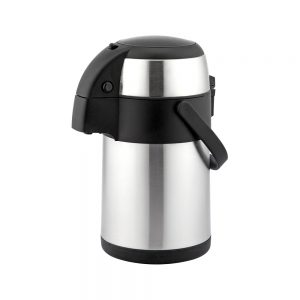
An air pot is a pump-action vacuum server — liquid is dispensed by pressing a button or lever on the top of the lid, which uses air pressure to push liquid through an internal tube and out of a fixed spout. The vessel never needs to be lifted or tilted during service.

Key characteristics:

  • Pump dispensing: fully self-service, no pouring skill required

  • Fixed upright position on counter or table — very stable

  • Typical capacity range: 2.5L to 4.0L for hotel and conference use

  • Heat retention: typically 8–12 hours for quality commercial models

  • No electricity during use

  • Low spill risk — pump controls the flow

Where it works best:

Air pots are the correct choice for self-service stations — hotel lobby coffee points, executive lounge counters, conference and meeting break tables, and catering buffet setups where guests or delegates serve themselves. The pump mechanism means guests of any age or ability can dispense a cup safely without risk of spilling.

For conference service in particular, air pots are the industry standard: they are filled in the kitchen, placed on the break table, and guests serve themselves throughout the session without any staff presence required.

Vacuum Jug

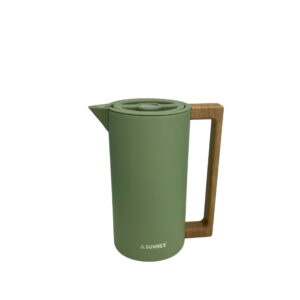
A vacuum jug is a pour-spout vacuum server — it is tilted and poured like a traditional jug, but with full vacuum insulation to maintain temperature for many hours.

Key characteristics:

  • Traditional pouring action with handle — served by a waiter or host

  • Typical capacity range: 0.75L to 3.0L — lighter and more portable than an air pot

  • More elegant table presence — suited to attended service

  • Heat retention: 6–12 hours depending on capacity and quality

  • No electricity during use

Where it works best:

Vacuum jugs are the correct choice for attended table service — a waiter carrying coffee to a restaurant table, in-room service where the jug sits on a tray for the guest to pour from, or an executive lounge where a host tops up cups personally. The jug format communicates care and service quality in a way that a pump pot does not; it is intentionally more personal and presentable.

The Sunnex vacuum jug range runs from 0.75L to 3.0L, available in polished stainless steel and the MSS Series matt black finish — a sleek, contemporary option increasingly chosen by boutique hotels and modern dining environments that want their service equipment to feel as considered as their interior design.

Beverage Pot / Thermal Beverage Server

A beverage pot is a larger-capacity countertop dispenser with a tap or spigot at the base, designed for group or extended-period service.

Key characteristics:

  • Dispensing via a base tap or push-lever spigot

  • Larger capacity: typically 3.0L and above

  • Designed to sit on a table and serve a group over a longer period

  • Self-service or attended

  • No electricity during use

Where it works best:

Beverage pots are suited to group settings where multiple people will be served from the same vessel over a longer period — conference room tables set for 10–20 people, meeting rooms with extended session times, and hotel suites hosting private events. Their larger capacity and stable tap dispensing reduce the need for frequent refills

What to Check When Buying

1. Lid seal and gasket quality
The lid gasket is the most common failure point in vacuum servers. A worn gasket breaks the vacuum seal and eliminates heat retention. Always confirm whether replacement gaskets are available as a spare part before purchase — this significantly extends the working life of the unit.

2. Internal tube cleaning (air pots)
The pump tube inside an air pot must be cleaned after every service. Models with removable pump assemblies are far easier to clean thoroughly than fixed designs. For commercial kitchens with high daily turnover, ease of cleaning is a practical operational requirement, not an optional feature.

3. Drip-free spout (vacuum jugs)
For table service, a drip-free spout is essential. A jug that drips onto guest tables or linens is an immediate quality signal — and not a positive one. Look for jugs with anti-drip pour spout design.

4. Finish durability
For any item that will be handled dozens of times per day in a professional kitchen and service environment, finish durability matters. The Sunnex MSS Series matt black vacuum jugs use a surface treatment specifically designed for commercial handling — maintaining appearance even after extended daily use.

5. Capacity matched to service window
A 1.0L vacuum jug in an in-room setting is appropriate for individual guest use across a morning. A 4.0L air pot at a conference station serving 30 delegates per session requires far greater capacity to avoid refills mid-session. Match the total volume to the expected service duration and guest count.

The Sunnex Range at a Glance

Sunnex offers a comprehensive insulated server range to cover all hotel and catering service scenarios.

Product TypeCapacity RangeFinishes Available
Vacuum Jugs0.75L – 3.0LPolished stainless steel, matt black (MSS Series), shiny black
Thermal Air Pots2.5L – 4.0LStainless steel
Insulated Servers (Double Wall)1.5L – 2.0LStainless steel

Whether the priority is elegant table service, practical self-service, or high-capacity group dispensing, matching the right format to the right service context is what turns an equipment purchase into a consistently positive guest experience.

Get the latest news and updates to your inbox

We only use your information to send you emails that are most relevant to your specific role in the foodservice industry.

Get the latest news and updates to your inbox

We only use your information to send you emails that are most relevant to your specific role in the foodservice industry.

Newsletter

Online Marketplace