

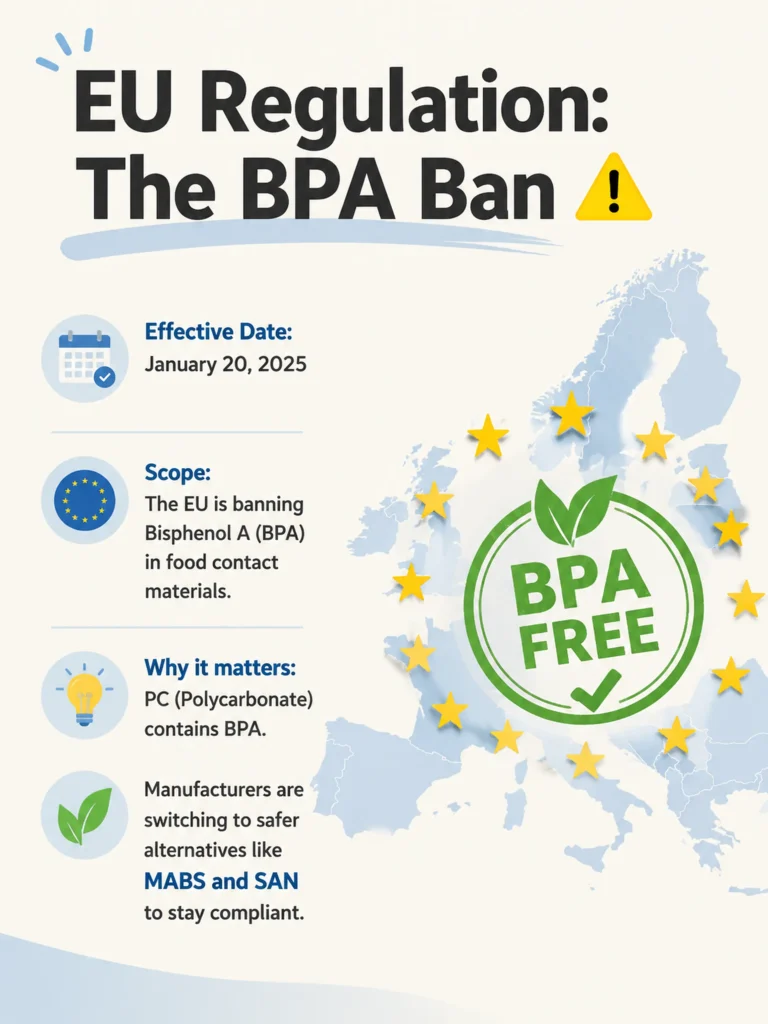
Since January 20, 2025, the European Union has enforced a sweeping ban on bisphenol A (BPA) in food contact materials under Commission Regulation (EU) 2024/3190 — and the main compliance deadline for most single-use and repeat-use articles has already passed as of July 20, 2026. For juice dispensers and other clear plastic foodware, this means polycarbonate (PC) containers are being phased out in favor of BPA-free alternatives like MABS and SAN.
EU BPA Ban 2026: Why Juice Dispenser Containers Are Switching to MABS & SAN
EU BPA Ban 2026: Why Juice Dispenser Containers Are Switching to MABS & SAN
What the EU Regulation Actually Bans
Commission Regulation (EU) 2024/3190, published in the Official Journal on December 31, 2024, prohibits the use of BPA and its salts in the manufacture of food contact plastics, varnishes, coatings, printing inks, adhesives, ion-exchange resins, silicones, and rubber. The regulation explicitly covers reusable plastic containers and water dispensers — placing juice dispenser containers squarely within its scope.
Why This Affects Polycarbonate Specifically
Bisphenol A is the core monomer building block used to manufacture polycarbonate plastic, meaning BPA is chemically embedded in PC’s molecular structure rather than simply mixed in as an additive. Peer-reviewed research confirms that BPA can leach out of polycarbonate containers over time, with leaching increased by the age of the material, alkaline conditions, and heat exposure — conditions a juice dispenser regularly encounters during cleaning and daily use. This is precisely why regulators singled out PC-based food contact articles as a priority for phase-out.
The Compliance Timeline Hotels and Caterers Should Know
The regulation set a general 18-month transition period for most final food contact articles, meaning non-compliant single-use and repeat-use BPA articles could still be placed on the market until July 20, 2026. A longer 36-month period, running until January 20, 2028, applies specifically to repeat-use articles used in professional food production equipment — a category that includes commercial juice dispensers, chafers, and similar B2B foodservice items. Stock already placed on the market before these deadlines can continue to be sold until exhausted, but new manufacturing of BPA-containing units for the EU market is no longer permitted after each respective cutoff.
What Replaces Polycarbonate: MABS and SAN Explained
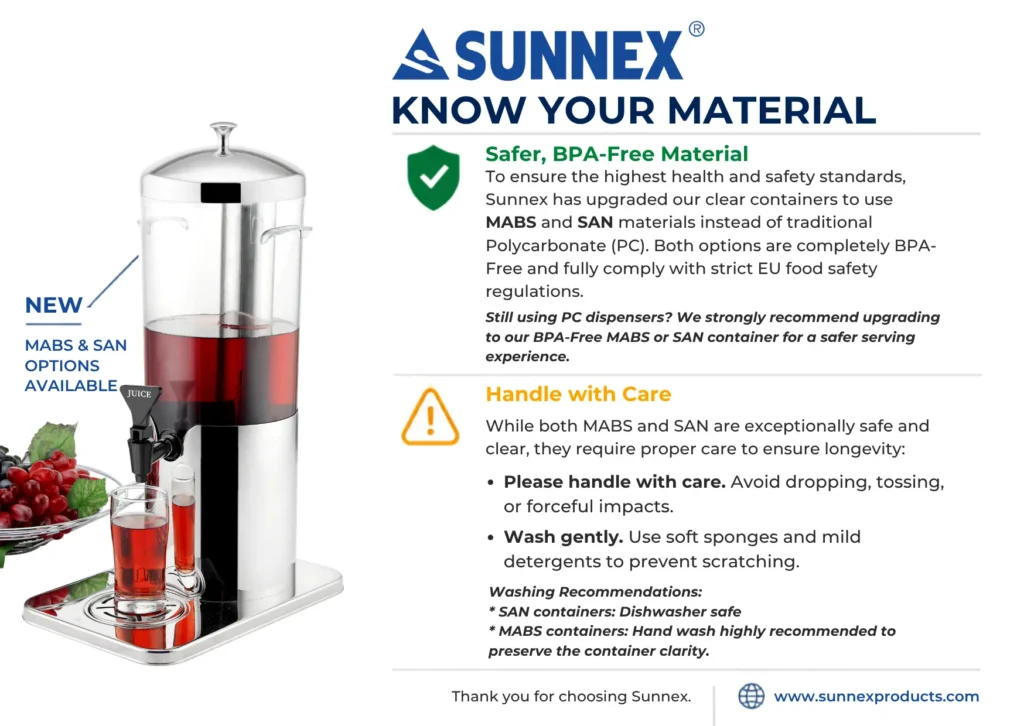
Sunnex has upgraded its clear juice dispenser containers to use MABS (Methyl Methacrylate Acrylonitrile Butadiene Styrene) and SAN (Styrene Acrylonitrile) instead of traditional polycarbonate — both materials are completely BPA-free and comply with strict EU food safety regulations.
MABS: Impact Resistance Meets Clarity
MABS is essentially ABS plastic modified with methyl methacrylate to achieve near-glass transparency, typically reaching light transmittance of 85-90% while retaining ABS’s impact toughness. Independent material data shows MABS achieving Izod impact strength around 170 J/m at 3.2mm thickness in room-temperature testing, and still maintaining 55 J/m even at -30°C, making it a reliable choice for containers that get bumped, dropped, or handled roughly in a busy service environment.
SAN: Proven Food-Grade Chemical Resistance
SAN is a mature, widely-approved food contact material under the US FDA (21 CFR 177.1040), the EU (Regulation 10/2011), and China’s GB 4806 standard, commonly used in water filters, coffee machines, and blenders. Compliant SAN carries residual monomer levels typically below 10 ppm, with actual food migration measured at under 1 ppb — far below the FDA’s 80 ppb limit and the EU’s Specific Migration Limit of 10 µg/kg for acrylonitrile. SAN is also dishwasher safe and offers high scratch and chemical resistance, though it is comparatively more brittle than MABS and should be handled with care.
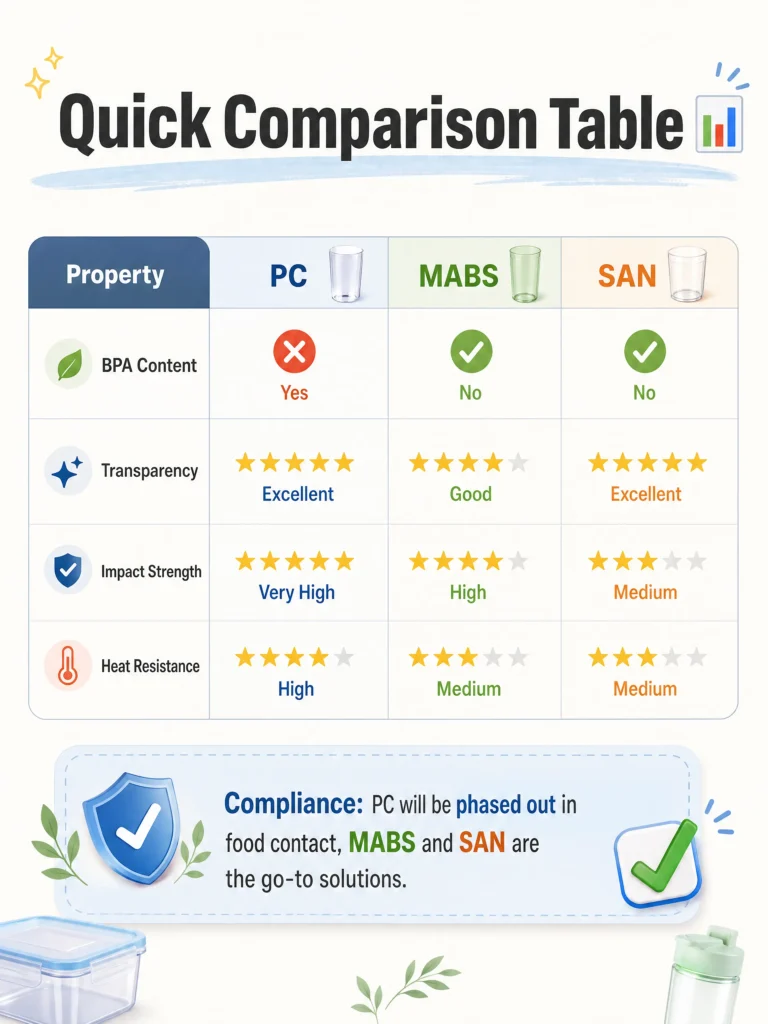
MABS vs SAN vs PC: Quick Property Comparison
| Property | Polycarbonate (PC) | MABS | SAN |
|---|---|---|---|
| Contains BPA | Yes | No | No |
| Light Transmittance | 88-90% | 85-90% | >88% |
| Impact Resistance | Very High | High — ~170 J/m at 23°C | Moderate — 18-25 J/m, more brittle |
| Dishwasher Safe | Generally yes | Hand wash recommended for clarity retention | Yes |
| Regulatory Status (EU FCM) | Being phased out under Reg. 2024/3190 | Compliant, BPA-free | Compliant under EU 10/2011 |
Care Instructions for BPA-Free Dispenser Containers
While both MABS and SAN are safe and clear, they require different handling than legacy PC containers to preserve longevity. Avoid dropping, tossing, or forceful impacts, and use soft sponges with mild detergents to prevent surface scratching. SAN containers are generally dishwasher safe, while MABS containers are best hand-washed to preserve container clarity over repeated use cycles.
What This Means If You're Still Using PC Dispensers
Operators still using polycarbonate juice dispensers should note that, under the EU regulation’s transition schedule, new manufacturing of non-compliant BPA-containing repeat-use professional food equipment is being phased out by January 20, 2028 at the latest. Upgrading to a BPA-free MABS or SAN container now avoids a future compliance scramble and gives guests a visibly safer serving experience in line with current EU food contact standards.




 YouTube
 Instagram
 Facebook
 LinkedIn