1. Visibility: See Before You Serve
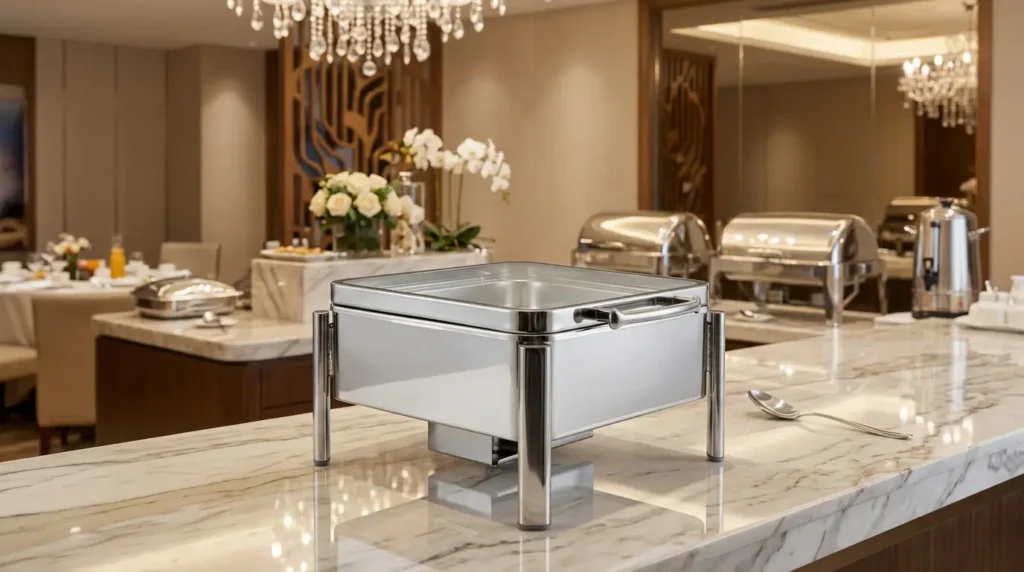
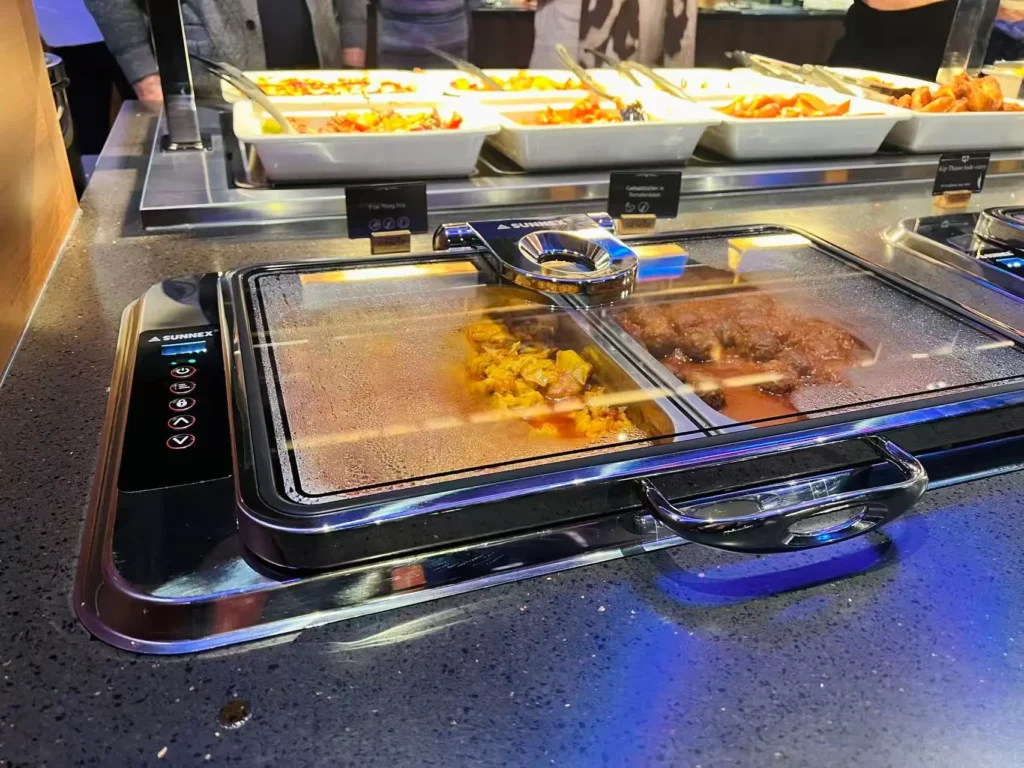
The most direct evolution in buffet equipment design over the past decade is the shift from opaque stainless steel lids to wide tempered glass window covers. The logic is straightforward: a glass window allows guests to assess the food without opening the cover, which simultaneously provides visual reassurance and preserves heat.
The Sunnex Roma, Burano, Vienna, Sicily, and Genoa chafer series are all designed around this principle. Each features a wide tempered glass window in the lid cover, explicitly described as enabling guests to “view the delicious food before opening the cover.” The practical benefit is twofold: the guest sees the food and its condition without needing to touch the equipment, and heat loss from unnecessary cover-lifting is reduced.
The Genoa and Venice electric chafer series take this a step further with a tempered glass cover design and a digital temperature display, meaning the guest does not just see the food — they also see the equipment operating at a defined, controlled temperature. For a guest consciously or unconsciously evaluating food safety, a visible digital temperature readout is a powerful confidence signal.
For hotel buffets to effectively leverage visibility as a trust mechanism, the CWD Hospitality guide to professional hotel buffet setup recommends that food covers — including sneeze guards and lidded chafers — should be considered not merely as protective equipment but as “a critical component of any buffet setup” that communicates professionalism and care to guests.
2. Hygiene: Prevent Cross-Contamination at the Point of Service
Hotel buffets are high-traffic, shared-utensil environments. Cross-contamination is one of the primary food safety risks specific to the buffet format — where multiple guests, with different hygiene habits, interact with shared serving equipment over a multi-hour service window.
The Hong Kong Centre for Food Safety (CFS) specifically identifies shared-use utensils and food-holding equipment as “high-touch areas” in buffets that require either frequent replacement or regular disinfection to reduce cross-contamination risk. The CFS recommends that hotels “facilitate frequent hand cleaning by providing sanitisers at convenient locations” and that food be protected while being transported from kitchen to display counters.
The physical design of buffet equipment directly affects how easy it is to meet these standards in practice:
Smooth, mirror-polished stainless steel surfaces on food pans and chafer bodies are easier to clean thoroughly and show contamination visibly, making it easier for staff to identify and address areas that need attention.
Detachable covers — a design feature called out in the Sunnex Chafer Series — allow lids to be removed and cleaned separately, rather than wiped in situ where contamination can accumulate around the hinge mechanism.
Anti-noise plastic knobs for quiet lid closure, featured in the Sunnex Roma, Burano, and Venice series, may seem like a presentation detail, but they reduce the physical wear on the hinge mechanism — meaning the cover maintains its clean, sealed fit over a longer service life.
3. Ease of Use: Self-Service That Feels Intuitive
A buffet is, by definition, a self-service format. The guest is expected to navigate the equipment independently. Any buffet equipment that requires effort, instruction, or physical exertion to use disrupts the guest experience and increases the likelihood of misuse — which can compromise both hygiene and food safety.
The most common friction points in traditional buffet equipment:
Heavy, fast-closing lids that slam or require two hands to manage while holding a plate — increasing the risk of guests propping lids open and leaving food uncovered
Stiff or awkward serving handles that make it difficult to serve cleanly without dripping or spilling
Opaque lids that require guests to fully open the cover to see what food is inside, leading to increased cover-lifting and heat loss
The advanced hydraulic hinge system across the Sunnex Roma, Burano, Vienna, Sicily, and Genoa series directly addresses the first of these friction points. The hinge opens and closes smoothly and silently, with a closing time adjustable from 20 to 40 seconds, and carries an 80,000-times guarantee — meaning the mechanism maintains its smooth-close performance through years of heavy buffet service use. A lid that closes itself slowly and quietly is also a lid that is less likely to be left open by guests who cannot manage plate and cover simultaneously.
The combination of the glass window and the hydraulic hinge is particularly significant: the guest can assess the food through the glass, then open the cover with one hand while the hinge holds the lid at a stable open position, then close it without effort. This removes all friction from the self-service interaction while ensuring the food is protected at every step.
TGP International’s 2026 Restaurant Design Trends report identifies guest wellbeing and a “smooth, low-friction experience from arrival to departure” as one of the defining hospitality design principles this year. In buffet terms, this means every piece of equipment a guest touches should feel intuitive and require no instruction.





 YouTube
 Instagram
 Facebook
 LinkedIn