

If you work in professional catering, you already know that the wrong pan in the wrong slot creates headaches on the buffet line — mismatched lids, food pans that do not sit flush in the chafer, and prep containers that do not fit the blast chiller. The solution is a thorough understanding of the GN pan sizing system: a global standard that makes every piece of your commercial kitchen equipment interoperable.
GN Pan Sizes Explained: The Complete Gastronorm Guide for Hotel and Restaurant Buyers
GN Pan Sizes Explained: The Complete Gastronorm Guide for Hotel and Restaurant Buyers
What Is a GN Pan?
A Gastronorm (GN) pan — also referred to as a steam table pan, hotel pan, or food pan — is a standardised food container whose outer dimensions follow the Gastronorm measurement system. The standard was first introduced in Switzerland in 1964 when industry associations agreed on compatible square dimensions for pans, trays, and kitchen inserts designed to maximise oven and refrigerator space. It was adopted as the official European standard in 1993 under EN 631.
Today, the GN sizing system is the default in virtually every commercial kitchen across Europe, Asia, the Middle East, and Australia. The only major exceptions are the United States and Canada, which maintain their own domestic system — though even North American operators increasingly source GN-compatible equipment for international hotel brands.
The GN 1/1 Module: The Foundation of the Whole System
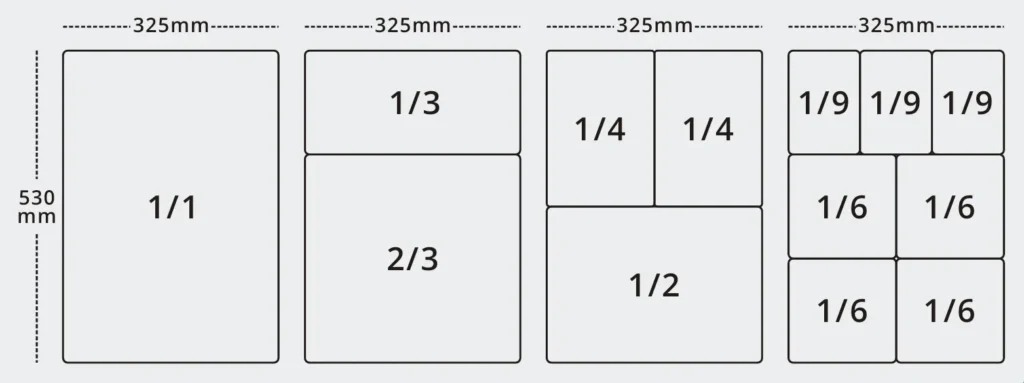
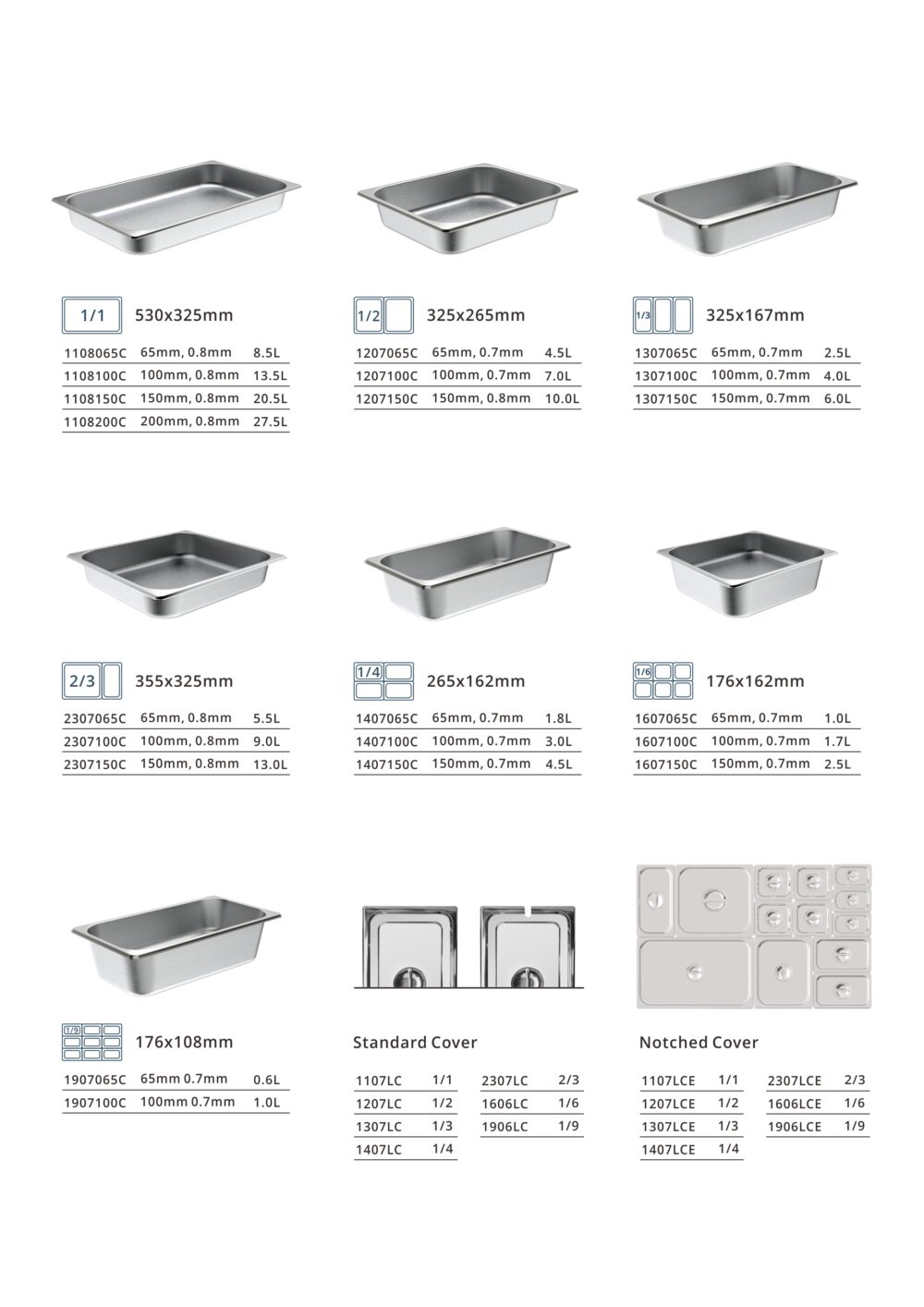
Every GN size is derived from one benchmark: the GN 1/1, which measures 530 × 325 mm. All other sizes are mathematical multiples or fractions of this base. This makes it straightforward to fill any given space in a chafer, oven rack, or refrigerated display unit using a combination of smaller pans.
GN Pan Size Chart
| GN Size | Dimensions (mm) | Also Known As | Typical Use |
|---|---|---|---|
| GN 2/1 | 650 × 530 | Double Full | Large-batch cooking, banquet roasting |
| GN 1/1 | 530 × 325 | Full Size | Buffet mains, hotel bain marie, chafers |
| GN 2/3 | 354 × 325 | Two-Third | Pasta stations, medium-volume dishes |
| GN 2/4 | 530 × 162 | Half Long | Narrow chafer inserts, elongated displays |
| GN 1/2 | 325 × 265 | Half Size | Side dishes, salads, breakfast buffet items |
| GN 1/3 | 325 × 176 | Third Size | Condiments, sauces, mise en place |
| GN 1/4 | 265 × 162 | Quarter | Small sides, garnishes, salad bar toppings |
| GN 1/6 | 176 × 162 | Sixth | Individual condiments, prep stations |
| GN 1/9 | 176 × 108 | Ninth | Portion control, condiment bars |
Understanding GN Pan Depth
Size alone only tells half the story. The capacity of a GN pan depends heavily on its depth. Standard commercial depths are 65 mm, 100 mm, 150 mm, and 200 mm. As a practical example, a GN 1/1 pan at 65 mm depth holds approximately 8.5 litres, while the same footprint at 200 mm depth holds 27 litres.
Choosing the right depth matters for two key reasons:
Food volume: A shallower 65 mm pan works well for dishes served at quick turnover (congee, scrambled eggs), while a 150–200 mm deep pan suits soups, curries, or large-batch protein dishes.
- Heat-up time: Shallower pans heat through more quickly, which is important when service begins and you need food to reach safe temperature fast. According to FDA guidance, hot buffet food must be maintained at 140°F (60°C) or above throughout service.
Which GN Size Fits Which Chafer?
Most rectangular chafers accommodate a GN 1/1 food pan, or two GN 1/2 pans side by side. Smaller 2/3-size chafers — popular in boutique hotels and restaurant buffets where counter space is limited — take a GN 2/3 food pan. Round chafers do not follow the GN standard as their name suggests; always check the inner dimensions against your food pan before purchasing.
Key practical rules when mixing and matching:
Anti-jamming GN pans prevent nested pans from getting stuck together in storage, a common operational headache in high-volume kitchens.
Lids are sold separately and follow the same GN designation — a GN 1/2 notched cover fits a GN 1/2 pan. Notched lids allow ladles and spatulas to rest without fully removing the lid, reducing heat loss.
- Perforated pans of the same GN size can be placed inside solid pans for steaming and draining, using the same equipment infrastructure.
The GN Pan Market: Why Standardisation Is Growing
The global gastronorm pan market was valued at approximately USD 1.17–1.51 billion in 2024, depending on the research source, and is forecast to grow at a CAGR of between 6.2% and 6.4%, reaching an estimated USD 2.0–2.1 billion by 2033. The Hotels & Restaurants segment is the single largest application area, contributing over 40% of global gastronorm pan market revenue.
The main growth drivers are the global expansion of buffet-style dining, stricter food safety regulations, and the increasing adoption of centralised production kitchens that rely on standardised container sizes.
Stainless Steel vs. Polycarbonate GN Pans: Which Should You Buy?
| Feature | Stainless Steel | Polycarbonate (PC) |
|---|---|---|
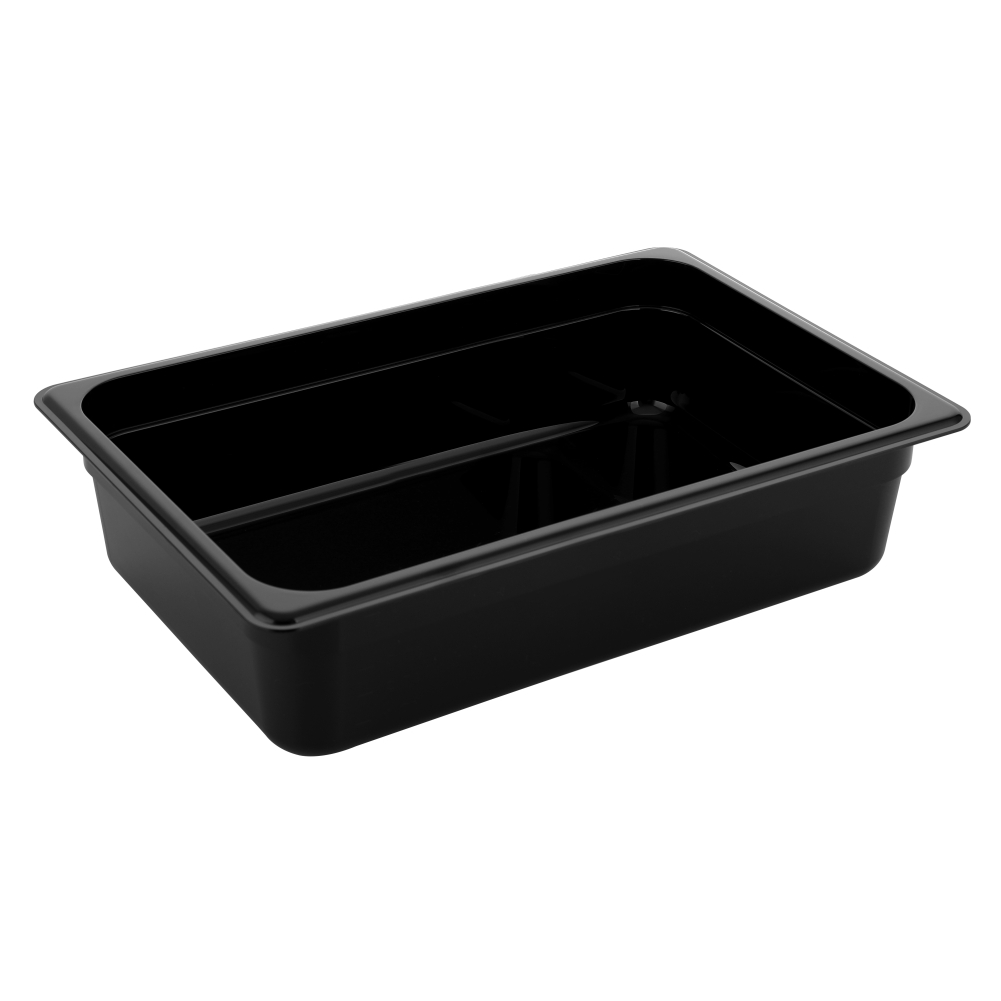
| Heat tolerance | High (suitable for ovens, chafers, bain marie) | Limited (cold storage only — not oven or flame safe) |
| Durability | Very high — resists denting, corrosion | Good — impact-resistant but scratches over time |
| Visibility | Opaque | Clear — allows staff to see contents without opening |
| Hygiene | Non-porous, dishwasher safe | Non-porous, dishwasher safe |
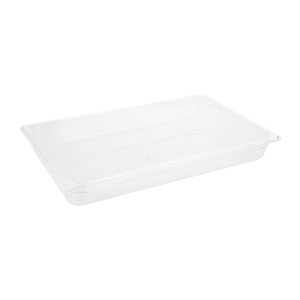
| Best for | Hot holding, cooking, blast chilling | Cold storage, cold buffet displays, salad bars |
For hot buffet applications and chafer use, stainless steel GN pans are the industry standard choice due to their heat tolerance, longevity, and compliance with commercial dishwashing.



 YouTube
 Instagram
 Facebook
 LinkedIn