

Soup service is one of the most consistently scrutinised aspects of a hotel buffet. Guests expect soups, broths, congees, sauces, and gravies to arrive at the table at the right temperature — not lukewarm, not scalding, but consistently hot and ready. Yet the equipment decision behind this seemingly simple outcome — the soup warmer — is one that many F&B managers approach without a clear framework. This guide covers the essential decisions: heating method, capacity, cover type, configuration, and how to match the equipment to your specific operation.
Electric Soup Warmers for Hotels
Electric Soup Warmers for Hotels
What a Soup Warmer Actually Does
This is the most important clarification for any buyer: a soup warmer holds food at temperature — it does not cook it.
Pre-cooked soups, broths, and sauces must always be brought to the correct serving temperature in a separate cooking vessel before being transferred to the warmer. The warmer then maintains that temperature throughout service, preventing the food from cooling into the danger zone. Attempting to heat cold food in a soup warmer will result in slow, uneven heating and potential food safety violations — the unit simply is not designed for that purpose.
This also means that pre-heating the warmer before service starts — typically 20–30 minutes before transferring food — is not optional; it is a standard operating requirement.
The Food Safety Baseline
Every soup warmer specification decision should start here: the minimum hot-holding temperature for cooked food in most major jurisdictions is 60°C (140°F). This is the lower boundary — food that drops below this threshold enters the temperature danger zone (5°C–60°C) where bacteria multiply rapidly.
In practice, hotel F&B managers should aim to hold soups and broths at 65–85°C during service — hot enough to exceed the safety threshold comfortably, but below a vigorous boil that would cause unacceptable evaporation, texture damage, and splashing risk at the service counter. Choosing a soup warmer with adjustable temperature control and a reliable thermostat is, therefore, a food safety requirement, not merely a convenience.
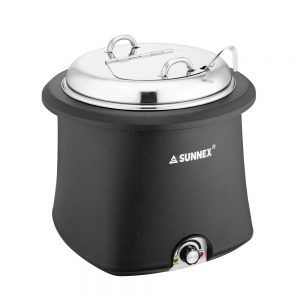
E07-1001
Heating Method: Wet Heat vs. Dry Heat
Commercial soup warmers use one of two heating approaches. Understanding the difference is the most important technical decision in the buying process.
Wet Heat (Bain-Marie) — The Standard for Liquid Foods
A wet heat soup warmer uses a water jacket — a water reservoir between the outer housing and the inner food container — as a thermal buffer. The heating element heats the water, and the water transfers heat evenly to the food container through the entire submerged surface area.
Why wet heat is the right choice for soups and liquid foods:
Heat transfer through water is extremely even — no hot spots that scorch the bottom of the food container
The water buffer acts as a temperature regulator, preventing rapid overheating
Ideal for foods with high liquid content: soups, gravies, congees, curries, sauces, custards
Gentle heating maintains the texture and flavour of delicate broths and dairy-based soups
The Sunnex Galena Soup Warmer series uses this wet heat bain-marie approach, with a 10-litre stainless steel bain marie and an aluminium water jacket for efficient heat distribution, running at 380W — an energy-efficient output for continuous service operation.

83388
Dry Heat — For Specific Applications
Dry heat soup warmers use a heating element in direct or radiated contact with the food container, without a water intermediary. These warm up faster, require less maintenance (no water to manage), and are simpler to clean. However, they are more prone to hot spots and uneven heating, making them less suitable for delicate liquid foods.
Best use cases for dry heat:
Sauces with high fat or oil content (less affected by uneven heat)
Bread, fried foods, or wrapped items (where moisture would be damaging)
High-turnover stations where speed of heat-up is critical
For a hotel soup station serving broth-based or cream-based soups, wet heat is strongly recommended as the default choice.
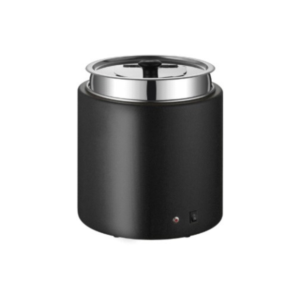
MECP10K
Galena & Electric Soup Warmer Series: What Sunnex Offers
| Model | Cover Type | Water Jacket | Ladle Included | Dimensions (mm) |
|---|---|---|---|---|
| 83388 | Stainless Steel | Stainless Steel | No | L365 × W365 × H430 |
| 81328 | Stainless Steel | Stainless Steel | No | L385 × W385 × H380 |
| 82328 | Stainless Steel | Aluminium | No | L385 × W385 × H380 |
| 82328L | Stainless Steel | Aluminium | Yes | L385 × W385 × H380 |
| 87328 | Polycarbonate | Aluminium | No | L385 × W385 × H380 |
| 87328L | Polycarbonate | Aluminium | Yes | L385 × W385 × H380 |
| 87328P | Polycarbonate | Stainless Steel | Yes | L385 × W385 × H380 |
Choosing between SS and PC covers:
Stainless steel (SS) covers — more durable, maintain a premium professional appearance over years of heavy use; recommended for front-of-house buffet stations visible to guests
Polycarbonate (PC) covers — lightweight and transparent, allowing staff to monitor food level and appearance without opening the lid; useful for back-of-house stations or where visual food monitoring during service is a priority
Electric Soup Warmer Series — Counter-Integrated Options
For operations where the soup station is a more prominent feature of the buffet — requiring a more integrated visual design — Sunnex also offers the E07 series electric soup warmers with stainless steel and PC cover options in black and brown housing colours, all at 10-litre capacity.
Maintenance and Daily Operation Checklist
A soup warmer maintained correctly will last years in commercial service. Key daily practices:
Before service: Add water to the jacket reservoir to the indicated MAX level using hot water to reduce pre-heating time
During service: Check the water level every 2–3 hours and top up as needed — the water in the jacket evaporates over time and a dry jacket will overheat the heating element
After service: Empty the food container immediately; allow the warmer to cool before cleaning the water jacket — never use cold water on a hot unit as thermal shock can damage seals and joints
Weekly: Descale the water jacket if operating in a hard-water area (common in many HK and mainland China hotel kitchens) — mineral deposits reduce heat transfer efficiency and shorten element life
Cover management: Always keep the lid on during service when guests are not actively serving — this maintains temperature and prevents contamination, while reducing evaporation from the food surface




 YouTube
 Instagram
 Facebook
 LinkedIn