

Choosing the wrong type of chafing dish affects more than just energy costs. It shapes how quickly your team can set up, how reliably food stays at safe temperatures throughout service, and how your buffet station looks to guests. With three main technologies now available — fuel-based, electric water pan, and dry heat waterless — this guide breaks down the real operational differences so you can make an informed purchasing decision.
Why Waterless Chafers Are the Future of Hotel Buffet Service
Why Waterless Chafers Are the Future of Hotel Buffet Service
The Core Problem: Buffet Food Safety Is Non-Negotiable
Before comparing technologies, it is worth grounding the decision in the regulatory standard that drives it. According to the US FDA, hot buffet food must be maintained at an internal temperature of 140°F (60°C) or above throughout service. The UK Food Standards Agency and Hong Kong Centre for Food Safety align closely, requiring hot food on display to be held at 63°C or above.
Failure to maintain these temperatures is not just a compliance risk — it is a food safety one. Bacteria multiply rapidly in the ‘danger zone’ between 5°C and 63°C, and a single buffet service with temperature failures can result in guest illness, reputational damage, and regulatory penalties.
The Three Types of Chafing Dish
1. Fuel-Based Chafing Dish (Traditional)
The original chafing dish design uses gel or liquid fuel canisters burning beneath a water pan, which in turn heats the food pan above through indirect steam heat. This setup requires no electricity and is genuinely flexible for outdoor use.
Strengths:
No power source required — suitable for outdoor events, remote catering, garden parties
Low upfront cost
Wide range of styles and finishes for any aesthetic
Weaknesses:
Ongoing fuel costs add up over time — operators replace canisters every 2–6 hours depending on the fuel type.
Temperature drops gradually as fuel depletes, making it harder to maintain the minimum 63°C requirement across a long breakfast service.
Open flame creates fire risk and is prohibited in some indoor venues.
Water pan adds setup complexity: water must be pre-heated before service begins.
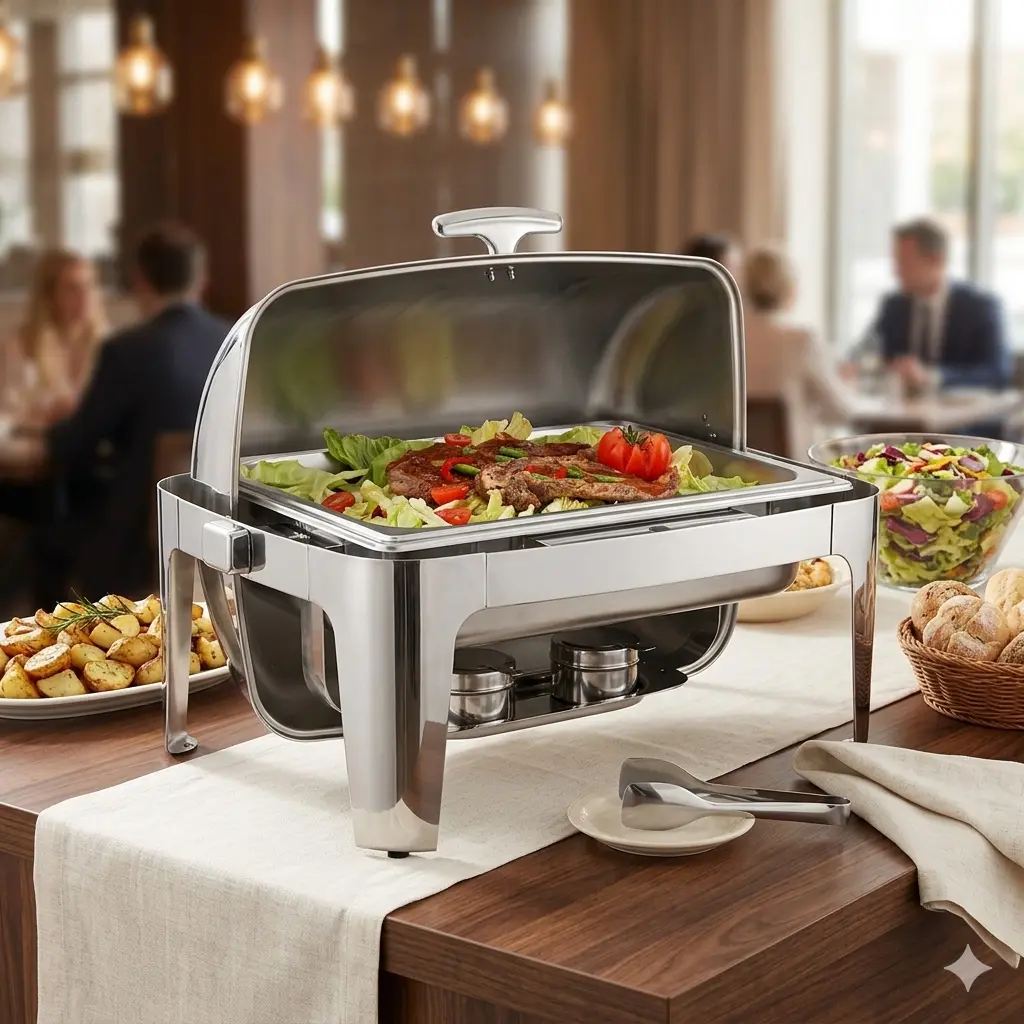
X32129V2
2. Electric Chafing Dish
Electric chafers replace the fuel burner with an electric heating element that warms the water pan below the food pan. Temperature control is more consistent than fuel, and there is no open flame.
Strengths:
Stable, consistent temperature throughout service as long as power is connected
Flameless operation — safe for all indoor venues and events where open fire is prohibited
More precise temperature settings than fuel models
Weaknesses:
Requires access to a power outlet, limiting placement flexibility on the buffet counter
Setup still involves filling and managing a water pan
Traditional electric chafers typically draw around high watts, representing a significant ongoing energy cost for hotel operations
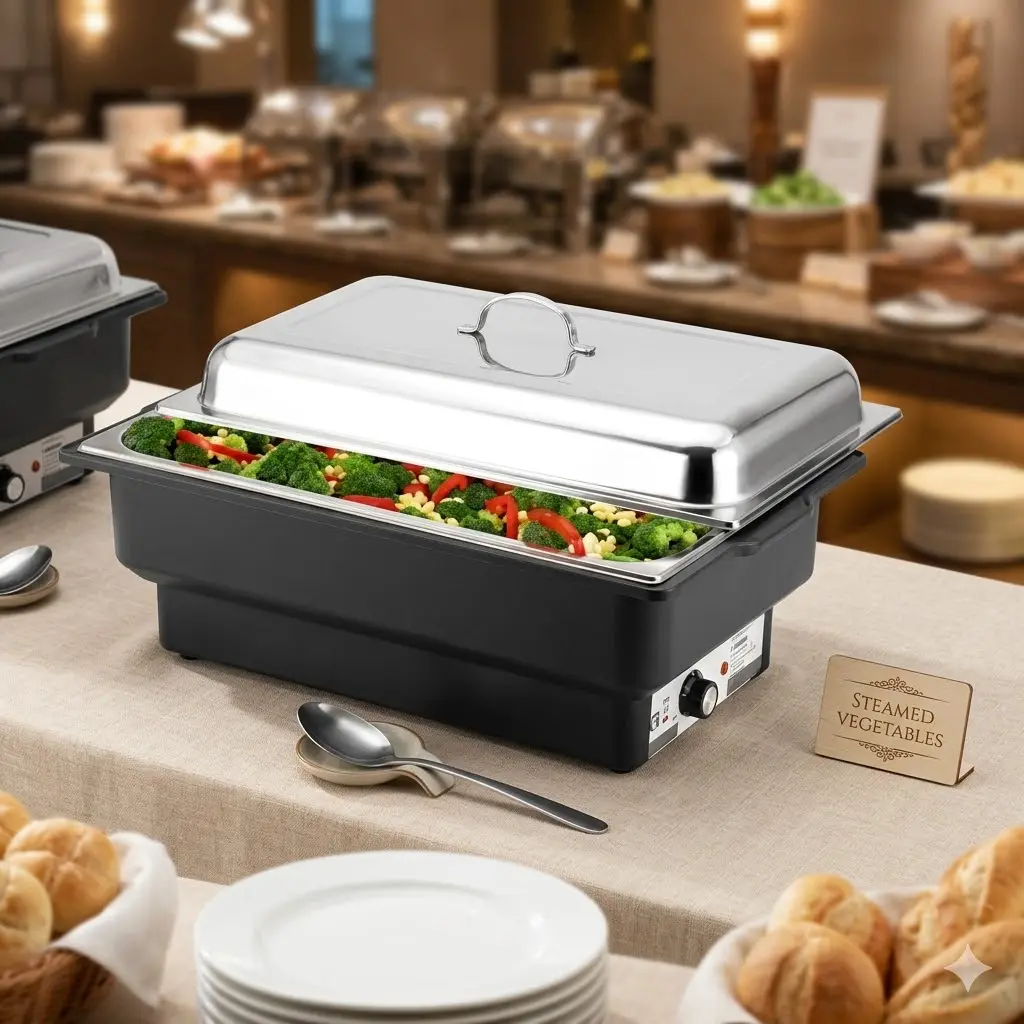
X81187
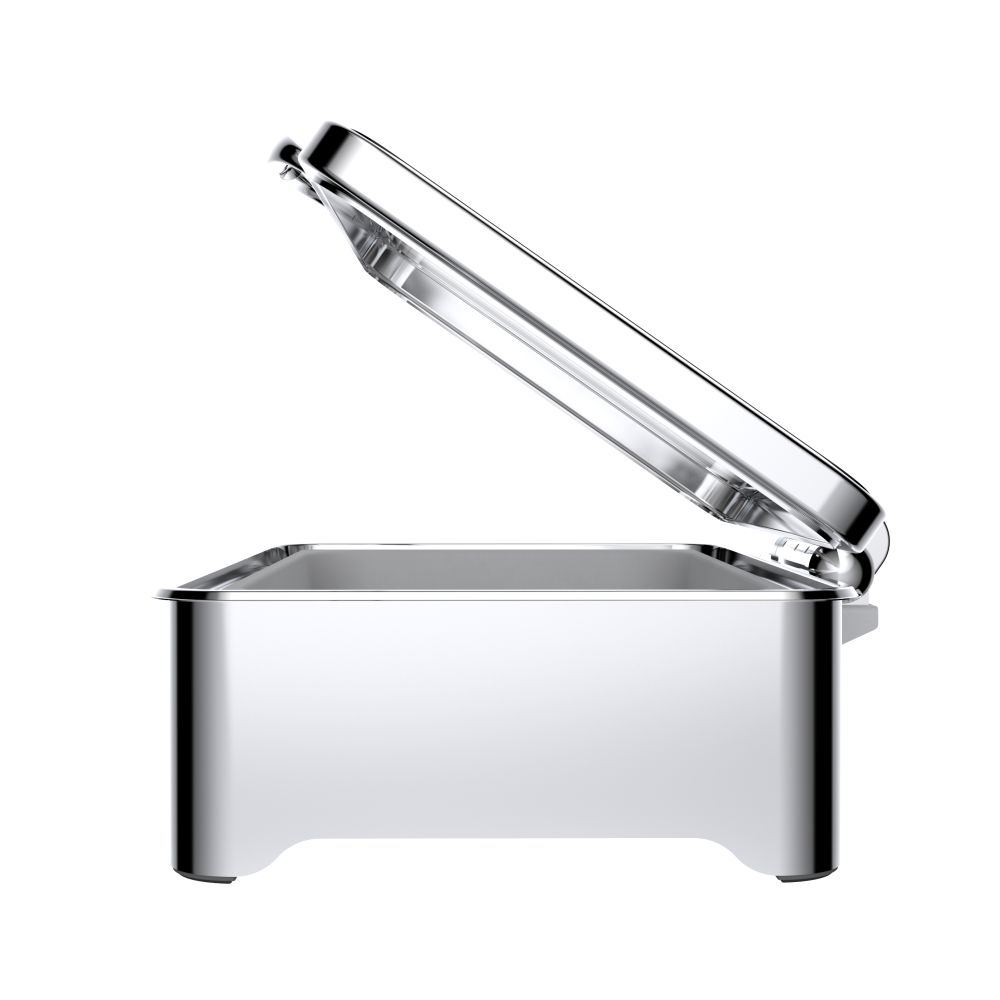
3. Dry Heat Waterless Electric Chafing Dish
The newest category is the dry heat waterless chafer, which heats food directly without using a water pan, using a precision-controlled heating rod to warm the food pan.
Strengths:
Energy savings of over 50%: Sunnex dry heat waterless chafers operate at 400 watts, compared to approximately 900 watts for older water-pan electric chafers — cutting energy consumption by more than half.
No water to pre-heat, fill, or clean — setup is faster and post-service cleaning is significantly easier
No spillage risk from water pan overflows during transport or repositioning
Faster initial heat-up time
Weaknesses:
Requires power access (same as all electric models)
Higher upfront purchase cost compared to basic fuel models
Best suited for indoor use; wind or extreme cold in outdoor settings can affect heat performance
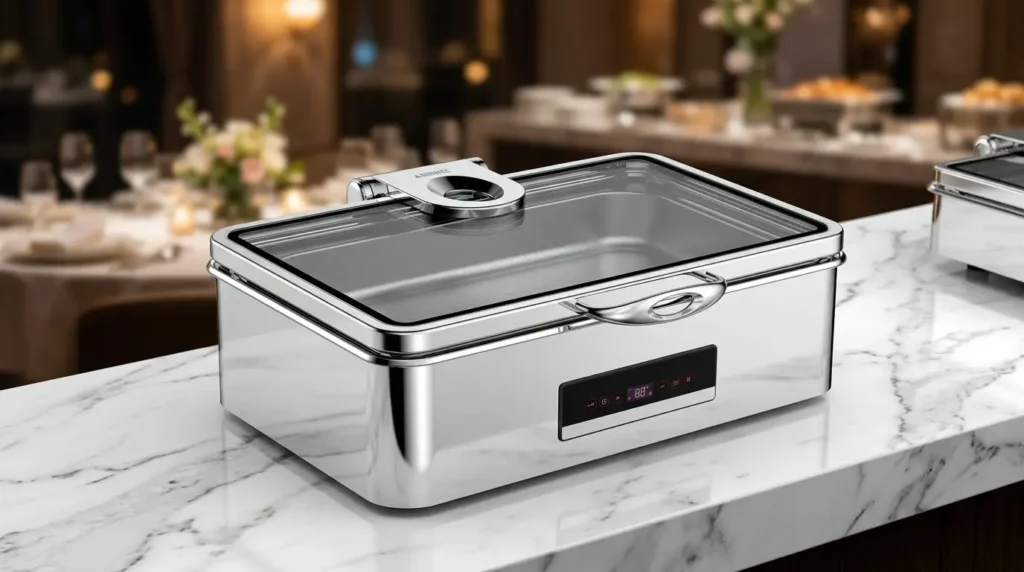
W21-11HLM5
Side-by-Side Comparison
| Feature | Fuel Chafer | Electric Water Pan | Dry Heat Waterless |
|---|---|---|---|
| Power required | No | Yes | Yes |
| Operating wattage | N/A (fuel cost) | ~900W | ~400W |
| Temperature consistency | Drops as fuel depletes | Stable with power | Stable with power |
| Setup complexity | Medium (pre-heat water) | Medium (pre-heat water) | Low (no water) |
| Indoor open flame risk | Yes | No | No |
| Outdoor flexibility | Excellent | Limited | Limited |
| Ongoing cost | Fuel replacement | Electricity | Electricity (lower) |
| Cleaning | Water pan + frame | Water pan + element | Frame only |
| Best for | Outdoor events, remote catering | Traditional hotel buffets | Modern hotel buffets, eco-conscious operators |
Real-World Performance: Not All Dry Heat Chafers Are Equal
Energy efficiency figures only matter if a chafer can actually maintain food-safe temperatures throughout service. Internal engineering testing conducted by Sunnex compared the Sunnex W21-11HLM against multiple dry heat chafer models available on the market under identical controlled conditions — 2 litres of water at ambient temperature, set to maximum, lid closed, tested over 4 hours.
The results revealed a significant performance gap between models:
- Two of the units tested failed to reach 70°C even after 4 continuous hours of operation, falling short of the 63°C minimum food safety threshold required by food safety authorities. For hotel operators, this represents a direct regulatory and food safety risk that no operational workaround can fully address
- The Sunnex W21-11HLM reached 69.8°C in 67 minutes and consumed 0.75 kWh over a 4-hour holding period.
- Critically, the Sunnex unit recorded an external handle temperature of only 39.5°C — among the lowest across all units tested — indicating well-managed thermal insulation that protects both staff and guests from accidental contact burns.
The key takeaway is straightforward: wattage rating alone does not guarantee performance. Two of the failing units carried the same 400W specification as higher-performing models, yet were unable to deliver food-safe results. The working principle — how heat is generated and transferred to the food pan — matters as much as the rated power figure.
Food Waste and Equipment Choices
Beyond energy, the choice of chafing dish also intersects with the food waste challenge that hotel operators increasingly face. Research by WRAP found that food waste in the hospitality sector amounts to approximately 18% of total food purchased, with breakfast buffets showing waste rates of 25–35% — the highest of any service type.
Equipment that maintains food temperature consistently — preventing food from being discarded due to temperature failures — directly supports waste reduction. A 2022 study published in NIH’s PMC identified accurate demand forecasting and improved buffet station design as key strategies for reducing buffet waste. Reliable, stable-temperature equipment is a prerequisite for any such strategy to work.
Performance Summary: Sunnex W21-11HLM0
| Parameter | Result |
|---|---|
| Working voltage | 220V ~ 50Hz |
| Rated power | 400W |
| Time to reach 70°C (2L water, 28°C ambient) | 67 minutes |
| 4-hour cumulative energy consumption | 0.75 kWh |
| External handle temperature during operation | 39.5°C |
| Meets 63°C food safety threshold | ✅ Yes |
| Heating principle | Thermal radiation + air heat conduction |




 YouTube
 Instagram
 Facebook
 LinkedIn